


Walter Roller MultiRef
Einsatz mit aktuellen sowie zukünftigen (brennbaren) Kältemitteln
Wir stellen unser bisheriges Produktportfolio an Luftkühlern für A1-Kältemittel kontinuierlich weiter auf den sicheren Betrieb mit brennbaren A2L/A3-Kältemitteln um.
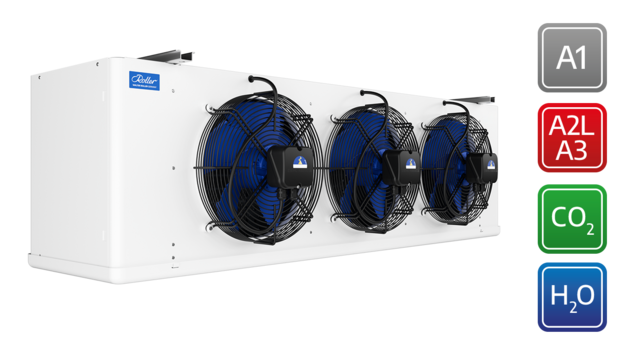
Um den Kunden die Übersicht zu vereinfachen, werden unsere A2L/A3-fähigen Verdampfer unter der Produktlinie MultiRef geführt.
Die bisher schon verfügbaren A2L/A3-Varianten für brennbare Kältemittel bleiben technisch gleich – es ändert sich nur der Name.
Die Bezeichnung MultiRef (multiple refrigerants) ist bei unserer Produktserie Programm. Der Einsatz ist für herkömmliche Kältemittel (A1), ebenso wie für zukünftige, brennbare (A2L/A3) möglich. Alle Bauteile der Geräte sind für Den Einsatz mit brennbaren Kältemitteln freigegeben. Die Produkte können daher problemlos schon heute in A1-betriebenen Systemen verwendet, und in der Zukunft, ohne technische Anpassungen am Verdampfer, mit A2L/A3 weiter betrieben werden. Dadurch ergibt sich ein hohes Einsparpotential auf Geräteseite.
Unsere Kältemittel-Signets mit Farbcodierung ermöglichen zudem eine schnelle Übersicht, für welche Kältemittel unsere jeweiligen Produkte geeignet sind.




Why switch to alternative refrigerants?
As part of the global effort to address climate change, stricter regulations are coming into force that ban more and more synthetic refrigerants. The F-Gas Regulation in force in Europe provides for a stepwise reduction in CO2 equivalents for refrigerants by 2030. Alternative refrigerants that have a low GWP are gaining in importance.
These include natural refrigerants, such as CO2, propane, and NH3, and chemical refrigerants, such as hydrofluoroolefins (HFOs), which, unlike natural refrigerants, generally do not require major equipment design changes.
However, the alternative refrigerants often have the characteristic of being toxic or flammable.

Flammability - a controllable risk:
For the facility design, decision criteria are available to assess the risk for the operation.
First, the safety class for flammability and toxicity must be determined.
If flammable refrigerants are used, the design must then comply with the specifications of the Machinery Directive and DIN EN 378 (2018). Here, the installation conditions, charging quantities and room volumes are considered in a risk assessment.
Independently of this, any planning should also be assessed according to its energy efficiency, environmental compatibility and life cycle costs.

Refrigerant safety classification
The hazard classification of refrigerants is defined by the safety classes according to ISO 817, which classifies them according to both flammability and toxicity.
The letters provide information on toxicity, the following number on flammability.
The currently used HFO refrigerant R454C falls into class A2L and is thus classified as low flammability.
System components must be safe
The basis for the construction and operation of a refrigeration system designed in accordance with DIN EN 378 is the use of approved components.
With regard to the use of evaporators for refrigerants of safety classes A2L and A3, it must be ensured that there is no risk of ignition or explosion (e.g. in the event of a leak). A possible trigger could be the very high surface temperatures of the electric heating rods.
According to EN 378-2, the maximum surface temperature on a component that may be exposed to a flammable refrigerant in the event of a leakage must not exceed the self-ignition temperature of the permitted refrigerant minus 100 K.
Roller MultiRef air coolers already meet the high safety requirements for use with flammable refrigerants:
Darauf können Sie sich verlassen:
Modifications for low-hazard operation of air coolers
- Special heating elements with reduced specific heat capacity
- Revised defrosting concept for block and tray to maintain max. permitted surface temperatures
- Optimized and tested heater placement for consistent defrost reliability
- Improved grounding concept against electrostatic charging of the housing
- Design tested for ignition sources and conforming to standards
Highest material quality
- Use of quality copper tubes mainly from German manufacturers
- Core tubes made of copper Cu-DHP with strong walls
- Heat exchanger block for operating pressures up to 80 bar with high pressure refrigerant CO2 (R744)
Quality and pressure test
- Manufacture according to Pressure Equipment Directive 2014/68/EU
- Pressure and leak test of the devices for refrigerants: 27.5 bar overpressure
- Pressure and leak test of the units for high pressure refrigerants: < 27.5 to 115 bar gauge pressure
- All units are subjected to a precise quality outgoing inspection
- Special pressure and leakage tests when using flammable refrigerants and CO2

Corrosion protection more important than ever:
When flammable refrigerants are used, the permanent tightness of all system components becomes even more important. For this reason, various types of corrosion protection are optionally available to withstand the chemical stresses caused by substances in the ambient air and subsequently prevent refrigerant loss.
This is what we offer you:
- Consulting on optimum corrosion protection
- Variety of different corrosion protection options
- Various fin materials
- Tin-plated copper core tubes for increased reliability against corrosion

How can we help you?
We consult you competently and comprehensively!
Make a concrete enquiry now!
Tel.: +49 (0) 7156 / 2001-29
lucas.hengster@walterroller.de


